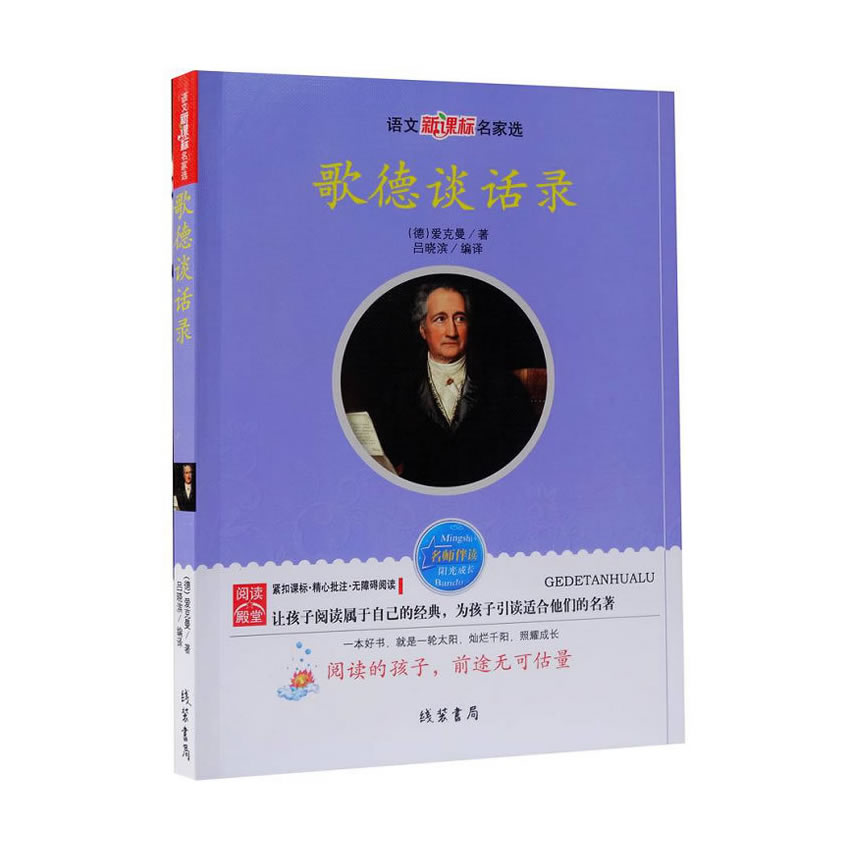
[Name] Goethe's Conversations
Written by (German) Ekman and compiled by Lv Xiaobin
[Publisher] Wire bound Bookstore
【 Open 】 16 open
[Page] 191 pages
【 Size and Weight 】 0.4
ISBN number: 9787512001664

Guide
Knowledge Link
1823
Weimar, June 10, 1823 (first meeting)
On June 19, 1823 (writing an introduction letter to Ekman to Jena)
Jena, September 18, 1823 (Advice to Young Poets)
October 29, 1823 (On the Difficulty of Mastering Individual Specific Things and Their Characteristics in Art)
November 3, 1823 (Regarding Goethe's Travels; On the Importance of Subject Matter in Literature and Art)
November 14, 1823 (On Schiller's obsession with abstract philosophy causing damage to his poetry)
November 15, 1823 (Wallenstein staged)
1824
January 2, 1824 (Shakespeare's Greatness; The Sorrows of Young Werther are irrelevant to the era)
January 27, 1824 (On the Continuation of Autobiography)
February 4, 1824 (Goethe's religious and political views)
……
1825
1826
1827
1828
1829
1830
1831
1832
Goethe's Conversations "is a summary of the most mature thoughts and practical experiences of Goethe, the greatest literary figure of modern Germany in his later years, compiled and organized by Goethe's friend Eckman. It involves philosophy, aesthetics, literary theory, creative practice, as well as daily life and attitudes towards life. It is a" treasure trove of Goethe's thoughts and wisdom "; It was once praised by the critical Nietzsche as the most important prose written in German, and is a world literary classic that embodies the words of the wise and approaches the world-renowned literary master Goethe.
Goethe's Conversations is divided into three parts, the first and second parts were published in 1836, and the third part was published in 1848. The 1930s and 1940s were revolutionary periods in German history, and due to Goethe's skeptical and distant attitude towards revolution, he became the target of attacks from democratic radicals. In this situation, Eichmann's book about Goethe's conversations naturally received a cold reception from the critics and the general readership. After the failure of the 1848 revolution, the political situation in Germany changed, and Goethe became increasingly valued by the public. Especially after the unification of Germany in 1971, Goethe became the "Olympian God", and the book that recorded the conversations of this "saint" became the "holy book".
The "Goethe Talks" records Goethe's speeches and activities in his later years regarding literature, aesthetics, philosophy, natural sciences, politics, religion, and general culture. It is an important first-hand material for studying Goethe, especially in the field of literature. It records Goethe's most mature thoughts and practical experiences in his later years. The period of "Goethe's Conversations" was the completion period of Goethe's greatest play "Faust", the second part of which Goethe himself talked about many times about his painstaking efforts in this play, which is enlightening for understanding the play itself and even general literary creation issues.
Many people naturally read it as a biography of Goethe, which more directly and prominently showcases Goethe's ideas on literature, aesthetics, philosophy, natural sciences, and so on. Therefore, it can also be called "Goethe's Conversations". In short, from the late 19th century to the 20th century, the vast majority of scholars regarded Eichmann's book as an objective and faithful record of Goethe's conversations, and as an absolutely reliable first-hand document.