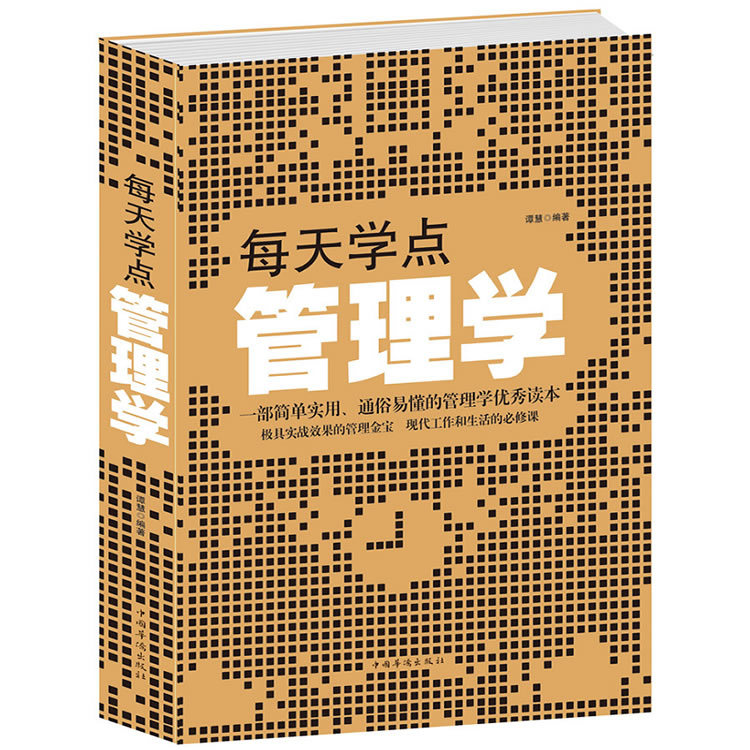
【 Name 】 Learn Management Every Day
[Author] Edited by Tan Hui
【 Publisher 】 China Overseas Chinese Publishing House
【 Open 】 16 open
[Page Count]
[Size and Weight] 0.90
ISBN number: 9787511341341

Chapter 1 Strategic Management: Ensuring the Achievement of Strategic Objectives
Strategic mistakes cannot be made
Cannot predict the future strategically
Seeking breakthroughs in business theory
Market positioning is a strategic focus
A successful strategy is pragmatic
A good strategy should have a sense of the future
To be able to translate into specific work arrangements
Targeting profits can be misleading
Any goal must be executed
Resolutely give up tasks without prospects
Achieving the future through scientific plans
Make efforts in the field of expertise
Chapter 2 Decision Management: Promoting Decisions to a Satisfactory Level
Decision making starts from the goal
Investigate before speaking
Don't be stingy in collecting information
The decision-making process does not exclude prediction
Advance decision-making in accurate positioning
Learn to apply traditional decision-making art
Skilled in utilizing four types of innovative decisions
Emphasize decision implementation tactically
We must adhere to the six musts in decision-making
Decisions must be able to respond to changes
Fully possess information that is beneficial for decision-making
Good decisions should focus on the future
Chapter 3 Competitive Advantage Management: Creating the Strength to Defeat Competitors in Seconds
Understand what cannot be done
Knowing oneself is more important than knowing one's opponent
Don't fight unprepared battles
Skilled fighters guide according to the situation
Concentrate various resource advantages
Capture the most valuable segments
Do not be a dwarf in action
A focused attitude is more important
Unexpectedly win by surprise
Leading competitors in technology
Find opportunities through the gaps
Don't cover your eyes with a weakness
Learn from the strongest opponent
Innovation is an eternal core capability
Looking for advantages from the customer's perspective
Study the success or failure of opponents
Chapter 4 Marketing Management: Making Customers Pay More Proactively
Who is suitable to be a marketing manager
Choose your subordinates and generals
Marketing management requires collective brainstorming
Marketing starts with market research
Capture consumer psychology
How to choose channel members
How to motivate channel members
Adjust and modify the channel system
Continuously strive to acquire new customers
Pricing strategies and methods
Effective price management
Win customers with honesty
Give customers ubiquitous love
Chapter 5 Cost Management: Building the Enterprise with the Least Internal Friction
Cost control is an idea
Resolutely oppose settling accounts after autumn
Need to follow certain steps
Strive to reduce material costs
Control the average wage level
Comprehensive cost control in daily operations
The Focus of Target Cost Control
Firstly, it is necessary to predict the target cost
Two ways to decompose target costs
The more decentralized the power, the stronger the internal control
The content of the responsibility cost system
Everyone is a center of responsibility
Determination and assessment of responsibility costs
Chapter 6 Organizational Structure Management: Creating an Effective Framework for Problem Solving
Analyze before designing
Principles of Organizational Structure Design
Identify each department
Job Design in Enterprise Organizations
The Four Major Problems in Organizations
We must help the organization lose weight
Organizational centralization and decentralization models
Don't be complicated or too broad
The more omnipotent, the more wrong it is
Adjust in line with strategic adjustments
What is beneficial for contribution is the best
Can actively promote internal communication
Promote employee self-management
Promote information flow rather than hinder it
First comes rewards, then heroes
Chapter 7 Personnel Management: Making Every Personnel Decision Right
Personnel decision-making is the most important
Employees are the customers of managers
Evaluation can only be based on performance
Promotion will definitely have side effects
Regard human resources as resources··
When using people, one should not be bound by conventions
Bundling employees with the company
Bring everyone to battle
Sending talent is better than giving money
Boldly introduce and use freely
We only accept harm without letting it go
How to assess fairly
Promoting too quickly is not conducive to growth
Only by understanding people can we know how to handle them well
Pay attention to the combination of people
Discovering hidden talents at the bottom
Provide the most suitable task
Chapter 8: The Art of Hiring People: Encouraging Every Employee to Work Automatically and Naturally
Hire the most suitable employees
Create the most effective working environment
Empowering means assigning responsibility
Arrange everyone's position correctly
Six Precepts for Managers
Believe in the people you are using
What is suitable is excellent
Blaming everything will lead to being alone
Criticism is a means, not an end
Four types of people cannot be reused
When using people, it varies from person to person
Satisfy employees' salary expectations
Anyone can use it multiple times
Place trust and high expectations on subordinates
Chapter 9: Flexible Management: Gaining Emotional Resonance from Employees
The connotation and essence of flexible management
Reasons for the emergence of flexible management
Four ways of flexible management
Communication is the guarantee of successful implementation
Employees are the ones who need to be thanked the most
Employee tension is the natural enemy of management
Management should thrive through harmony
The system has no lover but affection
The smile of subordinates is power
There is no style that is the best
Release your love and well-being
Emotional integration with employees
Subordinates are actually managers
Chapter 10 Innovation Management: Always Give Customers a Glimpse
Starting from a change of mindset
Cracking the obstacles to innovation
Innovation requires tolerance for failure
The birth of innovative thinking
Knowledge Economy Promotes Innovation
……
Chapter 11 Trend Management: Insight into the Future Today
Chapter 12 Change Management: Leading Others in New Opportunities
Chapter 13: Goal Management: Inspiring Passionate Organizational Members
Chapter 14 Authorization Management: Making Leadership Work Simple Again
Chapter 15 Team Management: Building an Efficient Team
Chapter 16 Organizational Image Management: Making Customers Fall in Love at First Sight
Chapter 17 Institutional Management: Shaping Professional Norms through Institutions
Chapter 18 Communication Management: Promoting True Understanding between Each Other
Chapter 19 Incentive Management: Transforming passivity into proactivity
Chapter 20 Performance Management: Making Performance Truly Play the Management Function
Chapter 21 Time Management: Not a Second Wasted
Chapter 22 Conflict Management: Making Conflict a Driver of Development
Chapter 23: Corporate Culture Management: Occupying Employees' Mental Resources
Chapter 24 Project Management: Identifying Differentiation Strategies
Chapter 25 Crisis Management: Eliminating the Causes of Crisis
Learning Management Every Day "is a simple, practical, and easy to understand management tool. The book is divided into 27 chapters, including strategic management, decision management, competitive advantage management, marketing management, cost management, organizational structure management, personnel management, employment art, and more. Combining real and vivid cases, it showcases management tips one by one and presents management principles to readers in a relaxed and lively way.