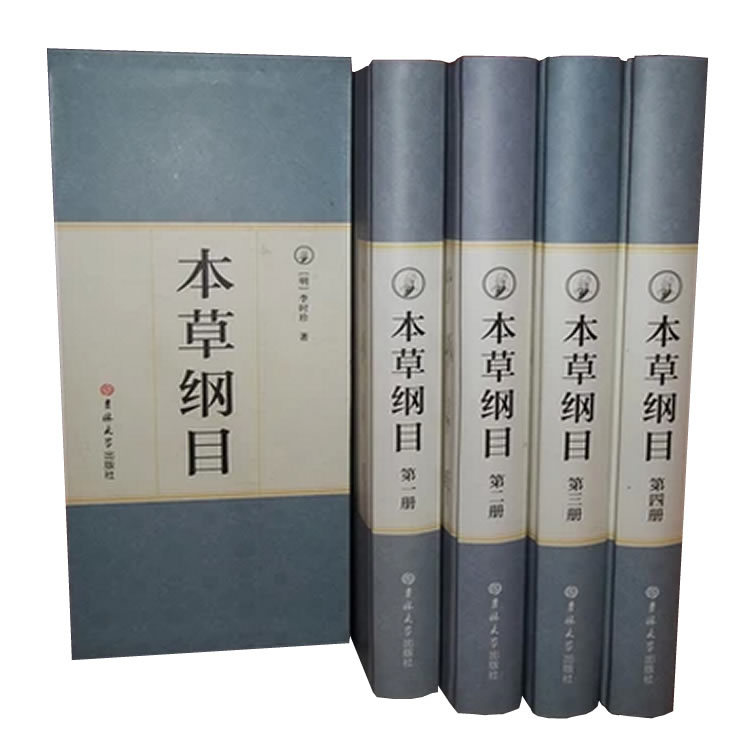
The Compendium of Materia Medica, with a total of approximately 1.9 million words, was written by Li Shizhen, an outstanding medical expert in the Ming Dynasty, who devoted his life to it. It was written in 1578 and first published in 1593. It is a precious scientific heritage in the ancient medical treasure trove of China. The book not only corrects several errors in traditional Chinese herbal medicine and integrates a large amount of scientific data, but also proposes a fairly scientific method for drug classification, dividing drugs into 16 parts based on their natural sources; The classification of the same drug into 60 categories based on similar orders has become a model for taxonomy. The book contains 1892 types of medicines, including 1094 plant-based medicines and the rest being mineral and other medicines. Li Shizhen added 374 new medicines. The book includes 1109 medication diagrams and 11096 prescriptions, of which over 8000 were collected or drafted by Li himself. Each drug is classified into categories such as name, interpretation, correctness, treatment, odor, indication, invention, and prescription. It has played a significant role in treating diseases and promoting people's health. And also made contributions to other related disciplines such as biology, chemistry, mineralogy, geology, astronomy, etc.
The Compendium of Materia Medica was first printed by Hu Chenglong in Jinling in the 21st year of the Wanli reign. Shortly after its publication, it spread to countries such as Japan, Korea, and Vietnam. In 1656, the Polish man Bo Miege translated the Compendium of Materia Medica into a Latin text, titled "Flora of China," and published it in Vienna, Europe. In 1676, Milan published an Italian translation, which was later translated into various languages such as French, German, English, and Russian after 1735.
British biologist Darwin also cited materials from the Compendium of Materia Medica multiple times in his works and referred to it as the "Chinese Encyclopedia" published in 1596. British technology historian Joseph Needham praised Li Shizhen as the "prince of pharmacology". In 1956, the renowned scholar Guo Moruo inscribed the inscription on the tomb of Li Shizhen, "The saint of medicine, the culmination of Chinese pharmacy, benefiting the people and extending the lives of many. Great is the master, who will live forever with the nation." On March 9, 2010, the Asia Pacific Regional Committee of the UNESCO "Memory of the World Project" announced in Macau that three precious Chinese documents, including the "Compendium of Materia Medica," had been officially included in the Asia Pacific "Memory of the World List.