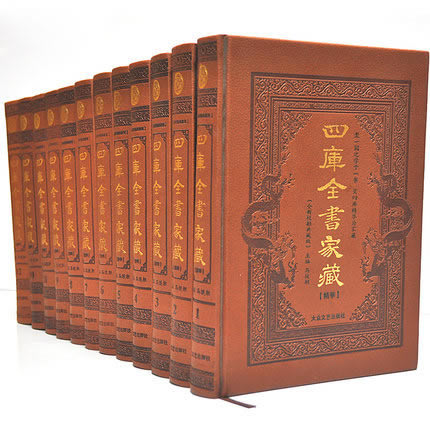
Content Introduction:
The largest line bound book publishing project; For the first time in over two hundred years, it was published in the form of handmade rice paper and thread packaging.
The Complete Library of Four Branches is the largest series of books in Chinese history. Emperor Qianlong of the Qing Dynasty mobilized 3826 scholars and took 14 years to complete the compilation and copying of the book. The book collects a total of 3461 ancient books and 79309 volumes, covering almost all the major classics in Chinese history before the reign of Emperor Qianlong of the Qing Dynasty. The Complete Library of Four Branches consists of seven books, of which only the Wenyuan Ge edition, Wenjin Ge edition, Wensu Ge edition, and Wenlan Ge edition still exist today. After 4 years of preparation, under the supervision of the Palace Museum in Beijing, Lujiang Publishing House and Gongde Pavilion have finally completed the largest scale rice paper bound book publishing project in Chinese history. This thread bound edition of the Complete Library of Four Branches is a photocopy of the Wenyuange edition, which is in large format. By adopting traditional publishing techniques such as handmade rice paper, manual printing, and manual binding, the academic literature value of "Siku Quanshu" has been fully preserved. The whole book consists of 1184 volumes, divided into 148 letters. The entire book uses 150000 pieces of Xuan paper and incorporates the Qianlong imperial seal "Wenyuan Ge Bao" and "Qianlong Imperial Appreciation" that have been sealed for over 200 years.
The Complete Library of Four Branches "is the largest collection of books in ancient China, with a total of 3461 types and 79309 volumes. It is divided into four parts: classics, history, literature, and collections, covering the main classics before the reign of Emperor Qianlong of the Qing Dynasty, hence the name" Complete Library ". The line bound edition of "Siku Quanshu" is a large eight part book, consisting of 1184 volumes and divided into 148 letters. Eight sets of bookshelves can fit in, priced at 390000 yuan. The publishing principle of the thread bound edition of "Siku Quanshu" is "affordable and easy to put down".
The thread bound edition of "Siku Quanshu" is made of handmade rice paper, printed by hand, and bound by hand, and can be passed down for a longer time than laminated books. The book is made of specially made antique gold paulownia wood letter plywood, which looks antique, elegant and luxurious, and has more ornamental value. The thread bound edition of "Siku Quanshu" is limited to 300 sets of printing and numbered for distribution.
The project is massive and unprecedented
During the reign of Emperor Qianlong of the Qing Dynasty, the compilation of the "Complete Library of the Four Treasures" was carried out by more than 3800 people. Each volume of the "Complete Library of the Four Treasures" consisted of over 36000 volumes, 6144 letters, 2291100 pages, and 770 million words, and took 14 years to complete. It can be called an unprecedented cultural project in Chinese history!
The silk bound edition of "Siku Quanshu" is another milestone in the history of Chinese silk bound book publishing, following "Mao Zedong's Commentary on the Twenty Four Histories" (silk bound edition).
Nearly a hundred experts, scholars, and professional technical personnel participated in the argumentation, cataloging, production, and proofreading of this book; Scan nearly 5400000 pages of the original book layout; We shared nearly 150000 pieces of handmade rice paper. If each piece of paper is laid flat on the ground with a total length of 27000 kilometers, which is equivalent to 10 times the straight-line distance from Beijing to Hainan Island, it would require over a hundred trucks with a load capacity of 5 tons to load it
Such a large amount of rice paper requires thousands of people to manually produce each piece. The traditional wire bound book printing process is complex, with dozens of steps including folding, aligning columns, punching, threading, and buttoning, all of which require manual completion. It can be imagined that the amount of work involved is enormous! At present, there are only five printing factories in China capable of producing large quantities of line bound books, among which three have fully invested in the production of "Siku Quanshu".
Jintongmu antique book frame
Xiaoyue Jintong wood, also known as Jintong wood, mostly grows in the sunny and arid northwest region. Unlike other paulownia trees, its wood is more delicate, warm, and lightweight, with clearer and more beautiful patterns that do not deform or become infested with insects. Therefore, it has been highly praised and loved by people since ancient times. In the 1960s and 1970s, the Japanese exchanged double the amount of cedar wood and 200 yuan per cubic meter for small leaf paulownia wood, which was used for high-end decoration in luxury homes, trains, and airplanes. This caused great damage to China's paulownia wood resources, resulting in a scarcity of resources and high prices today.
This time, small leaf golden paulownia wood was selected as the frame for the thread bound book "Siku Quanshu", and ancient craftsmanship was used to imitate the ancient style. The unique wood grain naturally stands out, elegant and luxurious, and the national color is heavenly fragrance, doubling the collection value.
The Siku Quanshu, completed during the reign of Emperor Qianlong, is the largest series of books in Chinese history. It includes 3461 types of books and 79309 volumes, almost covering the main classics in Chinese history before the Qing Dynasty's Qianlong reign. The Complete Library of Four Branches consists of seven copied books. Through the vicissitudes of time, three of the seven books have disappeared completely, leaving only the Wenyuan Ge edition, Wenjin Ge edition, and Wensu Ge edition to this day. The Wenlan Pavilion was originally damaged in many places during the war, but after additional copying, it was basically completed. The first copy of the Wenyuange edition, "Siku Quanshu," has been completed for over 220 years. Since the end of the Qing Dynasty, various sectors of society have repeatedly proposed to reprint the Complete Library of Four Treasures, but due to the massive project, it has been shelved.
General Consultant: Wang Zhongyu
Academic Committee Chairman: Ji Xianlin
Chairman of the Working Committee: Yu Youxian
Produced by the Palace Museum
Xuan paper thread packaging
Seventy four boxes of Jintongmu letters are divided into separate packages
出版社:鹭江出版社
Format: 620 * 1760 large eight format
Version: June 2004