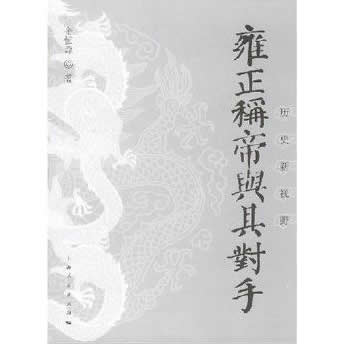
In September 1984, the People's Publishing House revised and rearranged Mr. Yahanzhang's "Biography of the Dalai Lama" based on Tibetan materials, according to the first edition published by Sanlian Bookstore in June 1963. In the Tibetan version of the "Biography of the Seventh Dalai Lama", the identity of Yin Zhen, the 14th elder brother, who "commanded the sixth division, stationed in Xining, paid for conscription, and dispatched troops in the middle" in the 57th year of Kangxi's reign, is recorded not as an ordinary prince, but as a "crown prince". Prior to this work, Mr. Meng Sen had already proposed in his research: "In the late years of the Holy Ancestor's reign, the kings and ministers silently prophesied that it was the 14th prince who agreed to let go of the divine artifact that would return in the future." This was a matter of "the people expected it to be so, and the superior intention was as it was," but it had not yet been officially announced.
Meng Sen's viewpoint coincides with what is recorded in Tibetan language materials thousands of miles away from the capital, and is consistent. This shows that, at that time, whether the princes and ministers in the palace, or the millions of soldiers and civilians in the capital, or even the high-ranking people or ordinary monks and herdsmen in Xizang thousands of miles away, in their minds, the status and image of Yin Zhen, the fourteenth elder brother, was naturally the status and image of a crown prince. It can be seen that the status and image of this Crown Prince were not self proclaimed or self proclaimed by the 14th Prince, nor could they be self proclaimed by several princes and ministers such as the 8th Prince in order to curry favor with Yinzhen. At that time, the status and image of the 14th Prince Yinzhen as Crown Prince were indeed intentionally established and created by Emperor Kangxi in his later years.
However, it was also from September 1985 that another new opinion emerged in the field of history. This new opinion holds that the status and image of the Crown Prince of the Fourteenth Prince was a self proclaimed wishful thinking of Yinzhen (i.e. Yunqi), and was created by several princes such as the Eighth Prince to spread rumors and attack Yongzheng, rather than historical truth. The new opinion also suggests that when Kangxi was dying, he decided to have his fourth elder brother Yinzhen succeed to the throne, and Kangxi had already chosen his fourth elder brother for a long time; It is said that Yinzhen conspired to usurp the throne, which was all caused by the false rumors and attacks of Ba A'ge and others who failed to plan for storage and refused to accept it. So, is it Meng Sen's research and Tibetan version of historical records that are closer to the historical truth, or are the new opinions after the mid-1980s closer to the historical truth?
In the face of this historical controversy, a premise that cannot be ignored must be raised, which is: for a long time, especially in the later years of Emperor Kangxi, what was the truth about the father son relationship between Kangxi and his fourth and fourteenth brothers Yinzhen? Without clarifying this premise, it is difficult to argue whether the posthumous edict of Kangxi will be tampered with and whether Kangxi's death is related to Yinzhen. If the historical truth is that Kangxi chose the Fourth Prince a long time ago, then of course, there will be no possibility of the Fourth Prince tampering with the will, nor will there be any possibility of the Fourth Prince plotting to kill the emperor, force his mother, or kill people to silence him; On the contrary, if the father son relationship between Yinzhen and Kangxi is not good, and there is a great hidden conflict of interests and a long time, then logically speaking, once the climate is favorable, it is very likely that the fourth prince will murder the emperor, alter the will, and even kill people to silence them. Of course, this is only logical and requires evidence from historical records and facts.
It is precisely for the above reasons that it is necessary for this book to use "Father son grudges, long-standing" as the first chapter.
Yongzheng was originally the reign title of Emperor Shizong of the Qing Dynasty, and later generations usually refer to Yin Zhen who became emperor.
The reason why Yongzheng has become one of the current hot topics is because he has colorful political charm and constantly controversial historical mysteries. Yongzheng devoted himself wholeheartedly to governance and aspired to become a leader of his generation. His aspirations and achievements in diligent governance, personnel selection, anti-corruption, and official reform have not only been praised by historians of ancient and modern times, but also attracted the attention of readers today. Moreover, with the continuous heating up of research on this historical figure, various controversies and differences about him have emerged one after another.
For example, when Yongzheng succeeded to the throne, was it due to competition among the princes and the dark horse winning, or was it due to the father son struggle between Kangxi and Yinzhen in the late Kangxi period? In the late Kangxi period, the struggle over whether to "depose" or "establish" a new heir to the throne was a power struggle within the palace, or a line struggle between different political platforms and forces? This naturally becomes a question that must be faced and answered when paying attention to and evaluating the historical figure Yongzheng. These issues are also one of the major differences between me and other researchers, and they are also one of the purposes of writing this book and attempting to explain them after my book 'The Original Clear Source of Yongzheng'.
Some people believe that although Kangxi did not like Yinzhen, Yinzhen ultimately gained (including deceiving) Kangxi's trust, so Kangxi ultimately chose Yinzhen.
Whether Kangxi ultimately chose Yinzhen or not can be traced back to the study of Kangxi's true attitude towards the princes, especially the fourth son Yinzhen and the fourteenth son Yinzhen (Yunqi), after the two deposed crown princes. This requires examining the true nature of Kangxi's father son relationships with the princes in his later years, which is a prerequisite for solving the mystery of Yongzheng's succession history. Without first addressing this premise, many other things will inevitably become entangled and unable to justify themselves. However, in the past two decades, there have been few in-depth studies on the relationship between Kangxi's later years and various princes and sons, which makes it necessary to conduct supplementary research.
In recent years, some researchers have only relied on the words of Yongzheng or the historical materials that Yongzheng used to cover up the relationship between Yinzhen and Kangxi, which is undoubtedly a fatal flaw. Some works, although quoting several words of Kangxi, lack a longitudinal coherence study of Kangxi's relevant original words and a horizontal internal causal argument of many events. They also lack a rigorous and systematic mutual verification of the logical and factual relationships between different time periods and events. Kangxi was a politician who hinted at the succession to the throne not just once, but multiple times. He would also take a series of actions in advance, such as granting him power, establishing his prestige, strengthening his power, and honing his abilities. These actions must be carried out openly and with great fanfare, and will never be carried out quietly and silently in secret, let alone keeping the selected successor Yin Zhen in the dark for a long time. This is not in line with historical logic. Therefore, why did Kangxi order the southern suburbs of Yinzhen to worship heaven, whether it implied his succession or was it necessary to transfer him out of the palace for some other important reasons at that time to take precautions against and control him? It is worth re studying seriously. An obvious question: If the Southern Suburb Sacrifice to Heaven was indeed an indication of his succession, and when Kangxi was seriously ill, he summoned Yinzhen to "arrive quickly", Yinzhen was a shrewd person who should have run the fastest and should have "arrived quickly". Why did Yinzhen resist the order and delay for more than 8 hours? To uncover the truth behind these questions, it is necessary to comprehensively consider the entire process of the Southern Suburban Heavenly Sacrifice during the late Kangxi period, including the entire history of the ceremony, both internal and external, as well as the official historical records that have been made public and the entire process that has not yet been made public. Especially after comparing all the words, deeds, and historical documents of Kangxi and Yinzhen father and son around the Southern Suburban Heavenly Sacrifice at that time, it is possible to find a reasonable answer.
Regarding Kangxi's statement that in ten thousand years, a "strong and trustworthy person should be chosen to make decisions with others," some scholars have suggested that "this person is none other than Yongzheng. The original words spoken by Cha Kangxi: "After ten thousand years, I will choose a strong and trustworthy person to make decisions with you, and I will make you fall in love and be pleased, so as not to burden your ministers." ("Yongzheng Dynasty Daily Annals", August 17th, Yongzheng Year) This is very clear. The "strong and trustworthy person" that Kangxi said must first be someone who can "make you fall in love and be pleased. So, whether during the lengthy 45 year reign of Emperor Yongzheng or the first 8 years of Yongzheng's reign as emperor after Kangxi's death, was Yongzheng someone who could "win the hearts and please of others"? Is he a person who will never burden his ministers? A large number of bloody historical facts, including Yongzheng's official books such as "Da Yi Jue Mi Lu", "Yongzheng's Daily Life Annotations", "Shang Yu Cabinet", "Zhu Pi Yu Yu", etc., have already provided vivid and objective answers.
Furthermore, although Kangxi once said, 'In ten thousand years, I will choose a strong and reliable person to make decisions with.' However, when Kangxi truly chooses, cultivates, and establishes a strong and reliable person, it must be properly implemented and resolved before his death, and it is impossible to solve it after ten thousand years or when he is dying. How can we solve it in ten thousand years or when we are barely alive? This was originally a necessary, unquestionable, or controversial issue. However, it was originally a question that needed no doubt or controversy, and it has actually been a topic that I have been debating with some experts in recent years. For example, some people use Yongzheng's steadfastness and achievements in governance after ascending to the throne as evidence that Yongzheng was a "strong and trustworthy person" in Kangxi's mind. May I ask, how could Kangxi possibly use something that he couldn't see or hear after his death as the basis for his ultimate choice of a "strong and reliable person" during his lifetime, and even for being able to "win the hearts and minds of others"? The situation should be the opposite of this. Kangxi must and can only rely on reliable facts that he has already seen and recognized as the basis for being a "solid and trustworthy person" and "winning the hearts and minds of others", which is more in line with historical logic.
For example, some people, in order to question or deny that Yongzheng came to power through a palace coup, propose that there was "no bloodshed" during Yongzheng's succession process. Throughout history, palace coups have been both bloody and bloodless. There are those who fail despite bleeding, and there are those who succeed without bleeding. Is it reasonable to use the phrase 'no bloodshed' as a basis for denying the coup? On the basis of deepening the research on the characters of Longkodo and Nian Gengyao, this book also excavated the previously unremarkable figure of the first class guard of Kangxi, Laxi, and further deepened the analysis of the character Zhang Tingyu. Before and after Kangxi's death, in addition to the two figures of Longkodo and Nian Gengyao, the two literary and military figures of Laxi and Zhang Tingyu also played a significant role in the conquest of the palace.
The existence and authenticity of the Kangxi testament should also be a significant issue in the process of Yongzheng's succession to the throne. Whether there is a will or not, whether it is true or false, researchers can put forward different opinions based on historical materials and facts. But it must be well founded and reasonable, at least it must be able to justify itself, and must not contradict itself; It is even more important not to start from personal beliefs and needs, saying that there is something, saying that there is nothing, saying that there is truth, and saying that there is falsehood. After all, history is not a girl who can be dressed up. Some researchers have already proposed that the posthumous edict is not credible, but at the same time, they use it as evidence to prove that Yongzheng's succession to the throne was "righteous and bright", without conspiracy, legal and normal, and could not be denied. Isn't this contradictory?
So some people suggested that in the study of Yongzheng, as long as historical evaluations of Yongzheng's achievements are made, there is no need to make moral judgments about him. And for example, wasn't Emperor Taizong the one who staged a palace coup and became emperor? But the question is precisely: why did people not relentlessly pursue the Tang Taizong palace coup, but instead refuse to let go of Yongzheng, who claimed to be entrusted and legally succeeded to the throne? It is said that this is because of sympathy for the failures. May I ask, were there no failures in the palace coup of Emperor Taizong of Tang? The second year of the Kangxi Dynasty's Yinchu era, which saw the establishment and abolition of two officials, was not also a failure. Why was there no public opinion that sympathized with Yinchu?
There is no doubt that moral evaluation cannot replace historical evaluation. So, can making historical evaluations of historical figures necessarily detach or even eliminate moral evaluations of them? This is also one of the important differences between me and some current researchers.
If official history is a history centered around people, then historical figures, whether classified as positive or negative, are ultimately living, flesh and blood, emotionally rich people, and will never be purely political individuals who are otherworldly and extraordinary. And all historical figures who have had a significant impact in history have their own distinct personality traits. These individual colors are bound to have a significant impact on the historical events of historical figures and leave distinct personal imprints in them. For example, he has lofty aspirations, a broad and open mind, courage, boldness, straightforwardness, kindness and generosity; Or naturally weak, indecisive, seeking pleasure, and lacking ambition; Or they may be greedy, lecherous, hypocritical, cunning, cruel, and so on. These are originally purely personal traits, personalities, or moral categories, but they are inevitably reflected in the relationships between historical figures, especially imperial figures, and play an important role in formulating systems, policies, and governance. Specifically on Yongzheng, there will inevitably be various influences. As soon as Yongzheng came to power, he engaged in secret storage, implemented the secret system, established the Military Affairs Office, and carried out large-scale activities such as demolishing bridges and killing people to silence them. In addition to Yongzheng's personal political needs, it was also closely related to his personality.
Mr. Inaba Junshan, a Japanese scholar who has conducted in-depth research on the history of the Qing Dynasty in China, once made a fair comment on this: "Emperor Yongzheng's character, as a politician, cannot achieve great success, because he cannot be without regret for being cruel and ungrateful." (Inaba Junshan: "The Complete History of the Qing Dynasty", Shanghai Academy of Social Sciences Press, 2006 edition, p. 58), Yu was deeply impressed by this. On the one hand, Yongzheng was a person with great ambition and achievements. He was resolute, decisive, diligent in governance, skilled in power and argumentation. On the other hand, this person is extremely dictatorial, extremely suspicious, and extremely cruel.
Moreover, Yongzheng was not a lecherous person either. The collection of the "Twelve Beauties of Yongzheng" in the Forbidden City in Beijing is evidence of this; The presence of many beautiful women accompanying in the "Yongzheng Xingle Tu" is another clear evidence. There were actually far more than 8 women in Yongzheng's reign, and that was just the number publicly announced on the surface of official documents. There are 24 people who have been buried underground with Yongzheng for a long time in Xiling. Additionally, there are 6 individuals with documented evidence, totaling 30 people. If Yongzheng had not died suddenly, this number would have increased. But the emperor had numerous concubines, which was a privilege in feudal society. To prove whether Yongzheng was lustful, it cannot be based solely on this, but requires further research to draw conclusions.
Yongzheng is undoubtedly a person with a dual personality and wearing two masks. He had both positive contributions to the Qing Dynasty and even to Chinese society, as well as negative impacts. In addition to his unavoidable historical limitations, he was inevitably inseparable from his personal character, personality, or moral realm.
Focusing on the status and role of individuals in history, while also attempting to distill personal traits, personalities, or moral categories from their historical events, thoughts, emotions, and ways of dealing with things, seems that imperial figures are purely political figures. I think it is not advisable to oppose and separate historical evaluations from the moral imprints and evaluations of historical figures. Let's take a look at historical figures from ancient China, such as Qin Shi Huang, Emperor Wu of Han, Emperor Taizong of Tang, and Zhu Yuanzhang; the Western world, such as Lincoln, Washington, Napoleon, and Hitler; the late Qing dynasty in China, such as Empress Dowager Cixi, Emperor Guangxu, and Emperor Xuantong; and the Republic of China era, such as Yuan Shikai. Which historical figure can distill the personality and moral evaluation of this figure and make a purely political historical evaluation? Which major event of theirs does not reflect their distinct personality traits?
What kind of people there are, what kind of things will happen. In the same era and social context, the reason why earth shattering or incredible historical events occur in this person rather than in another person, and historical events have different colors, is because things are man-made, and people are living beings with different personalities. In the late Kangxi period, the reason why it was the fourth prince Yinzhen who launched a palace coup and plotted to seize the throne, rather than the third prince, eighth prince, or fourteenth prince, had both historical contingency and historical inevitability, which included Yinzhen's personality factors and colors of firmness, decisiveness, wit, and cruelty. The power struggle in the imperial court during the late Kangxi period, which revolved around the re establishment of the "deposed" or "established," can be evaluated as a struggle of different political platforms. It seems that Yinzhen's rise to the throne was for the fate of the country and the people, which is by no means the true face of history.
The growth and development trajectory of each historical figure is different, and their personalities, moral values, values, desires, pursuits, efforts, means, processes, results, etc. are inevitably different. The occurrence, development, and changes of their historical events will also inevitably follow different results. This may be another clich é. However, in practice, some researchers often intentionally or unintentionally ignore or deny the causal law between people and things, and ignore or deny the constraining role of human nature, character, political aspirations, moral ethics, values, means, etc. in historical figures and events.
When I was giving a speech in the history department of a certain university, a graduate student asked, "Can there be competition between princes when inheriting the throne?" This book once again presents a completely different view on whether Yongzheng's rise to power was the result of prince competition and Yinzhen's victory. Who is right and who is wrong? We dare not be arrogant and can delve deeper into the discussion. But I can understand the meaning of this classmate, that is, the succession to the throne can be contested among princes, and whoever has the ability will ascend; As long as the emperor is done well, how did he come to power? I know, this viewpoint is still quite popular nowadays.
But with all due respect, this is still a historical perspective or research method that distills personal traits, personalities, motivations, or moral categories from historical events when evaluating historical figures. It is also a misunderstanding of the term (or means) of "competition". The harmfulness and danger of such misunderstandings are not only due to differences or disagreements in the evaluation of a certain historical figure, but also because such competitive ideas will directly affect the values, behavior, and political concepts of contemporary and future generations. If evaluating a person's political achievements and actions can cancel the evaluation of their personality and morality, then are all corrupt officials throughout history people without any political achievements or actions? Which corrupt official or bad emperor in ancient and modern times, both in China and abroad, is not someone with extremely poor personal morality? This historical view or research method that abandons moral evaluation, regards the goal as everything, and promotes success at all costs to achieve the goal, and even calls it "competition", is by no means a scientific development view. It does not conform to the historical materialism and historical dialectics, nor does it meet the needs of building a harmonious society. Any competition in any era must be conducted in a legal and orderly manner. Without legality and order, it is not the true meaning and essence of competition. If the two red lines of legality and orderliness are abolished, the purpose is everything, and the means can be ignored, then for athletes, gold medals and trophies are everything. Whether or not doping is taken can be exempted from investigation. Is this still a fair and just "competition"? Whether Yongzheng gained Kangxi's trust and competed for power, or came to power through a palace coup, and whether Yongzheng's employment, anti-corruption, and diligent governance were all positive aspects, whether there were any negative aspects, are still worth further exploration and in-depth research. Starting from the many grudges and relationships between Yongzheng and his opponents, including his father Kangxi, this book may help to increase a more comprehensive understanding and recognition of Yongzheng's character and actions.
Reading history can be a leisurely enjoyment, as well as a way to broaden one's horizons and stimulate contemplation; It can be a hobby or a pursuit of knowledge and responsibility. I have all four factors mentioned above.
Reading and studying history is a process of continuous exploration, discovery, summarization, and progress. All participants have put in effort on the research achievements of predecessors and others, leaving behind their own difficult climbs and long journeys. If this book can provide readers with some new explorations and discoveries, and add some new historical perspectives or reference inspirations when introducing the complex relationship between Yongzheng's claim to be emperor and his opponents' mistakes and entanglements, I would be satisfied. I look forward to your help and criticism.