Publisher: Shanghai People's Publishing House; First edition (February 1, 2006)
Flat: 290
Format: 16
ISBN:9787208059207
Barcode: 978720059207
Product size: 22.6 x 14.8 x 1.8 cm
Product weight: 340 g
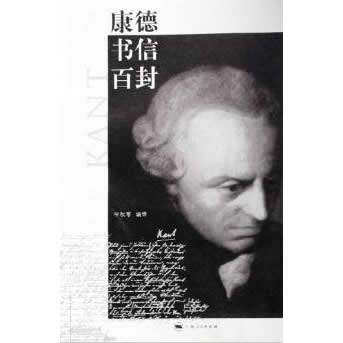
The letters of Kant are an integral part of Kant's philosophical thought, which forms the process of Kant's philosophical thought in a dynamic way. They are also a faithful witness to Kant's life and career. This book selects one hundred important letters from different periods of Kant's life, reflecting his writings, teaching, communication, religion, morality, and other aspects. The book also includes three short essays by Kant on the issues of freedom and enlightenment, which are excellent materials for studying and understanding Kant's thoughts and life.
So far, more than 300 letters from Kant have been discovered. This book, "The Hundred Letters of Kant," is mainly selected from volumes 10-13 of the Complete Works of Kant published by the Academy of Sciences, which is the second part, and translated based on this version. In addition, the compilation process also referred to the selection of the first and 50th letters from J. Cai Bei's "Collection of Letters from Kant"; K. Flanders compiled "Kant and His Undertaking"; R. Eisler's "Kantian Dictionary"; Arlin Guliuga's "Kant's Biography", translated into Chinese.
Kant's letters are an important component of Kant's philosophical thought system. They not only contain many important explanations and interpretations of Kant's own philosophical system, forming an important supplement to Kant's philosophical works, but also dynamically reproduce the process of Kant's philosophical thought formation. At the same time, they are also faithful witnesses to Kant's life and career. How to successfully embody Kant's thoughts and life in these limited hundred letters is a demanding task. In terms of compilation, the principle followed by compilers is: on the one hand, they should try to select stable letters that are most valuable for studying Kant's thoughts and life as much as possible, and on the other hand, they should also take into account the continuity of Kant's life in different periods to avoid blank spaces. Therefore, they adopted the method of chronicles in terms of format, that is, arranging them in chronological order.
1. To Leonhard Euler (1749.8.23)
2. To Albrecht von Halle (1749.8.23)
3. To King Frederick II (1756.4.8)
4. To the President and Senate of the University (1758.12.11)
5. To John Gottfried Lindner (1759.10.28)
6. To John Heinrich Samuel Formen (1763.6.28)
7. To Miss Charlotte von Knobloch (1763.8.10)
8. To John Heinrich Lambert (1765.12.31)
9. To Moses Mendelssohn (1766.4.8)
10. To John Gottfried Herder (1768.5.9)
11. To John Heinrich Lambert (1770.9.2)
12. To Marcus Hertz (1771.6.7)
13. To Marcus Hertz (1772.2.21)
14. To Marcus Hertz (end of 1773)
15. To John Caspar Lafayette (1775.4.28)
16. To Christian Heinrich Volker (1776.3.28)
17. To Marcus Hertz (1776.11.24)
18. To Marcus Hertz (1777.8.20)
19. To Joachim Henrich Kampe (1777.10.31)
20. To Marcus Hertz (early April 1778)
21. To William Crichton (1778.7.29)
22. To Christian Heinrich Volcker (1778.8.4)
23. To Marcus Hertz (1778.8.28)
24. To Marcus Hertz (1778.10.20)
25. To Marcus Hertz (1778.12.15)
26. To Marcus Hertz (1779.1)
27. To John Jacob Engel (1779.7.4)
28. To Marcus Hertz (1781.5.1)
29. To Marcus Hertz [Manuscript] (1781.5.11 onwards)
To John Erich Bicester (1781.6.8)
31. To John Bernoulli (1781.11.16)
32. To Christian Galway (1783.8.7)
33. To Moses Mendelssohn (1783.8.16)
34. To John Schultz (1783.8.26)
35. To John Schultz (1784.2.17)
To Christian Gottfried Schulz (1785.9.13)
37. To Christian Gottfried Schulz (end of November 1785)
38. To John Belling (1786.4.7)
39. To Christian Gottfried Schulz (1787.6.25)
40. To Ludwig Heinrich Jacob (1787.9.11)
41. To Karl Leonhard Reinhold (1787.12.28, 31)
42. To Karl Leonhard Reinhold (1788.3.7)
43. To John Schultz (1788.11.25)
44. To Henrich Jung Stirrin (after March 1, 1789)
45. To Karl Leonhard Reinhold (1789.5.12)
46. To Karl Leonhard Reinhold (1789.5.19)
47. To Marcus Hertz (1789.5.26)
48. To Friedrich Heinrich Jacobi (1789.8.30)
49. To Ludwig Ernst Borowski (1790.3.25)
50. To John Gottfried Carl Christian Kisevertel (1790.3.25)
51. To Franz Theodor de Lagard (1790.3.25)
52. To John Gottfried Carl Christian Kisevertel (1790.4.20)
53. To Johann Friedrich Blumenbach (1790.8.5)
54. To Auguste Wilhelm Reiberg (1790.9.25)
55. To Christopher Friedlich Helvag (1791.1.3)
56. To Jacob Sigismund Beck (1791.5.9)
57. To Karl Leonhard Reinhold (1791.9.21)
58. To Jacob Sigismund Beck (1791.9.27)
59. To Jacob Sigismund Beck (1791.11.2)
To Jacob Sigismund Beck (1792.1.20)
61. To John Gottlieb Fichte (1792.2.2)
62. To Maristi á n Gottlieb Celle (1792.2.24)
63. To Miss Maria Herbert (Spring 1972)
64. To Jacob Sigismund Beck (1792.7.3)
65. To John Erich Bicester (1972.7.30)
66. To the Theological Seminary (end of August 1792)
67. To Jacob Sigismund Beck (1792.10.16)
68. To Jacob Sigismund Beck (1792.12.4)
69. To John Benjamin Ahmed (1792.12.21)
70. To Karl Sch ö bner (1793.3.22)
71. To Abraham Gottfried Kestner (1793.5)
72. To Karl Friedlich Stuttling (1793.5.4)
73. To John Gottlieb Fichte (1793.5.12)
74. To Georg Heinrich Ludwig Nikolai (1793.8.16)
75. To Karl Leonhard Reinhold (1794.3.28)
76. To John Erich Bicester (1794.5.18)
77. To Jacob Sigismund Beck (1795.7.1)
78. To Joachim Henry Kampe (1794.7.16)
79. To King Frederick William II [Draft] (1794.10.12 onwards)
80. To Francis Theodor de Lagard (1794.11.24)
81. To Carl Friedrich Gustav Kasten (1794.12.4)
82. To Dietrich Ludwig Gustav Kasten (1795.10.15)
83. To Friedrich Schiller (1795.3.30)
84. To John Gottfried Carl Christian Kisevertel (1795.10.15)
85. To William Houffand, Christopher (1797.4.19)
86. To Christian Gottfried Schulz (1797.7.10)
87. To Jacob Lindstrom (1797.10.13)
88. To Johann Heinrich Tiftron (1797.10.13)
89. To John Gottlieb Fichte (1797.12)
90. To Johann Heinrich Tiftron (1797.12.11)
91. To Johann Heinrich Tiftron (1798.4.5)
92. To Friedrich Nikolai (1798.5.9)
93. To Georg Christophe Lichtenberg (1798.7.1)
94. To Christian Galway (1798.9.21)
95. To John Gottfried Carl Christian Kisevertel (1798.10.19)
96. Statement on the Relationship with Fichte Knowledgeology (1799.8.7)
97. To John Benjamin Erhard (1799.12.20)
98. To Carl Gottfried Hagen (1800.4.2)
99. To John Gottfried Carl Christian Kisevertel (July 8, 1800)
100. To Karl Christopher Sch ö n (1802.4.28)
Appendix
A Universal Historical Concept Originating from the Intentions of World Citizens
Answer a question: What is enlightenment?
Re posed question: Is humanity constantly progressing towards goodness?