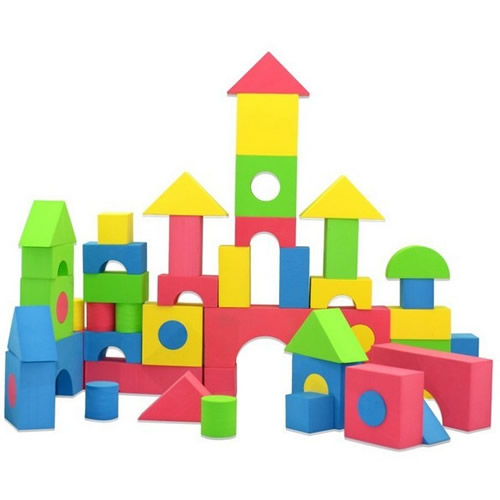
Product Name: Children's Building Blocks
Number: BB-01
Specification: 30 pieces packed in PVC bags
Target audience: Children aged 3-12 (This product may contain small parts or balls, and children under 3 years old are prohibited from using it)

Gameplay: Building block gameplay:
1. Double the amount
Pair two identical rectangular building blocks into a square, two triangles into a square, two semicircles into a circle, and so on. This game can help children understand the relationship between different shapes and their combinations, as well as concepts such as parts and whole. Moreover, during the process of playing, children need to use their eyes to observe whether different shapes of building blocks can match each other, which is very beneficial for cultivating observation skills.
2. Building a house
Use various shapes of building blocks to construct houses. By building houses with building blocks, children can understand the principles of simple architecture. For example, symmetrical left and right structures are more attractive; Place a small triangle on a pre built house to prevent the roof from collapsing, while placing a large triangle may cause it to collapse. Children learn to compare, contrast, summarize experiences, and so on from it.
3. Assembled and tell a story
Prepare a set of assembly building blocks, which includes furniture, dad, mom, baby, etc. Teach children to assemble building blocks according to their own wishes, and then use language to tell family stories. Mothers can make up stories with their children. This game can also stimulate children's imagination.
4. The building blocks have collapsed
You code the building blocks one by one, and when they reach a certain height, have the child push them down with their hands. Children usually laugh happily when they see building blocks falling down. Although this is just a simple game of "destruction", it is an important activity for children to improve their spatial cognitive abilities.
5. A winding path
Teach children to arrange long blocks at certain intervals to connect them into a winding path. Give the child another toy car, and he can play with the car along this "path", preferably without touching the building blocks. This can exercise children's ability to visually perceive spatial distance, cultivate their sense of three dimensionality and hand eye coordination skills.
6. Bowling
First, arrange cylindrical building blocks of different colors into an inverted triangle. Then, let the child leave a distance and roll a ball towards the building blocks to knock them over. As children's abilities improve, they can gradually increase their distance. This game requires children to have a sense of direction, which is also helpful for improving attention and exercising physical coordination.
7. Dominoes
Arrange the building blocks in a domino like pattern, then knock down the first or last block in the row and enjoy the fun scene of the blocks falling in order. In the process of placing building blocks, children need to accurately judge the spatial distance and require precise hand movements and high concentration of attention.
Building blocks embody many principles of mechanics. For example, building blocks of different sizes have varying levels of stability, and those with good stability are less likely to collapse; Building a house with building blocks will gradually make children aware of relationships such as balance and symmetry. Before building blocks, children need to have a plan for what to build below and what to put on top. All of these are greatly beneficial for cultivating scientific thinking.
8. Seesaw
Place blocks of the same color and size on both sides of the seesaw and try their balance. You can also place blocks of different sizes and quantities to see which side is lighter and which side is heavier. Through continuous experimentation, children learn to distinguish relationships such as quantity and weight, which helps establish concepts such as weight and balance.
10. Build a small bridge
Teach children to arrange square blocks at certain intervals and use them as bridge piers, with the distance left in the middle representing the bridge opening, and then place long blocks on top to use as a bridge. Bridges also need to have a certain slope so that people or cars can walk on them. Children may use triangular blocks to build two gentle slopes. What is the appropriate slope? Children need to think. In simple bridge building activities, children will demonstrate their usual observations of things very well.
11. Build a castle in a fairy tale
After telling a child a fairy tale or reading a storybook, they can be asked to personally construct the context in the story. For example, after telling the story of "The Three Little Pigs", children can use different materials to build three rooms. Build a paper box to represent a grass house; Build a wooden house with building blocks to represent it; Then use plastic to assemble one, representing the strongest stone house. When building, children need to reproduce the story plot and conceptualize game content in their minds, which can effectively cultivate their expressive and creative abilities.
12. Build a home for small animals
Children love small animals very much, and we can encourage them to build a home for their favorite animals. Continuously raise new requirements for children during the construction process. For example, teach him a few windows so that small animals can see the scenery outside; Build a staircase for small animals to go upstairs and play; Build another small bed so that the small animals can sleep when it gets dark. This can not only cultivate children's creativity and imagination, but also inspire their love.
13. Can you guess what it's fitting for?
Build some common objects with building blocks, such as airplanes, trains, ships, etc. Mom and child build separately and guess at each other to see if they can guess correctly, or compare who has built more and more realistic objects. This is very helpful for cultivating children's hands-on ability and imagination.
Benefits: Stimulate babies' interest in hands-on activities, cultivate their awareness of reasonable combinations and spatial imagination, and enable them to recognize different colors and shapes. Exercise the baby's hand eye coordination ability, understand geometry, distinguish colors, count quantities, and recognize shapes. Improve babies' imagination, exercise their thinking ability, and improve their wrist coordination from an early age!
Intellectual development:
While children are thinking about how to place building blocks and what shape of blocks to place, they use their brains to think and promote the full development of their male and female counterparts, thus promoting their intellectual development!