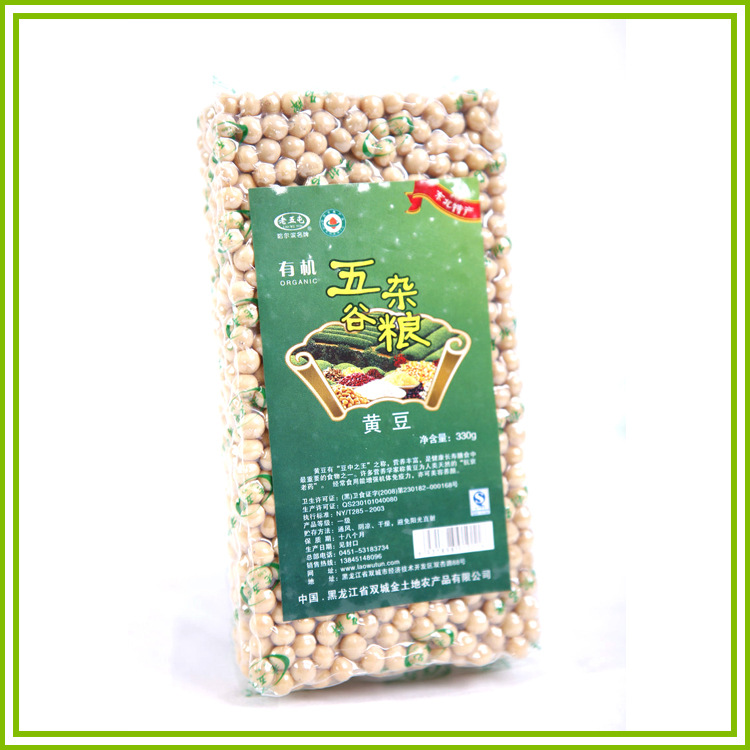
[Product Features]
The color is golden The aroma of rice is rich The fragrance is overwhelming Both color and taste are excellent Comprehensive nutritional content
【 Nutritional Composition 】
Soybeans contain a fatty substance called linoleic acid, which can promote children's neurological development. Linoleic acid also has a cholesterol lowering effect in the blood, making it a good food for preventing hypertension, coronary heart disease, arteriosclerosis, and other conditions. Soybeans also contain abundant B vitamins and inorganic salts such as calcium, phosphorus, and iron. Although dried soybeans do not contain vitamin C, they can produce vitamin C after germination and can be supplemented during the off-season of vegetables.
Chinese scholars have different views on the origin of soybean cultivation. Lv Shilin (1977) believed that soybean cultivation began in China as early as the Shang Dynasty (1800 BC, 102 BC). Ma Yuhua and Zhang Kan (1983) believe that soybeans originated and were domesticated in China. Soybean cultivation in China has a history of over 5000 years. Soybean is one of the oldest crops in China. Regarding the origin location, in 1974, Wang Jinling, Meng Qingjia, and Zhu Qichang analyzed the photoperiod characteristics of wild soybeans from southern China to Hengyang in Hunan Province and northern China to Heilongjiang Province. They found that wild soybeans in the Yangtze River Basin and its southern regions had the strongest short-term photoperiod in their original traits. Therefore, it is believed that the Yangtze River Basin and Jiangnan region in China should be the center of soybean origin. The soybeans in this region, due to their early maturity variation with weak short light exposure, variety types and variations, and a long agricultural history, may also have been selectively selected from local wild soybeans in the northern region. In this way, the origin of soybeans in China is polycentric. Lv Shilin (1977) believed that the origin of soybeans in China was polycentric. According to two reasons: firstly, there are regions in northern and southern China with early cultural development and written records of soybean cultivation; The second is that wild soybeans are widely present, and the degree of short day in wild soybeans varies from place to place, and the short day nature of cultivated soybeans also varies greatly, which precisely indicates that the origin is polycentric. Xu Zhanyou et al. (1999) found through SSR marker research that Shanxi Province is one of the origin centers of soybeans.